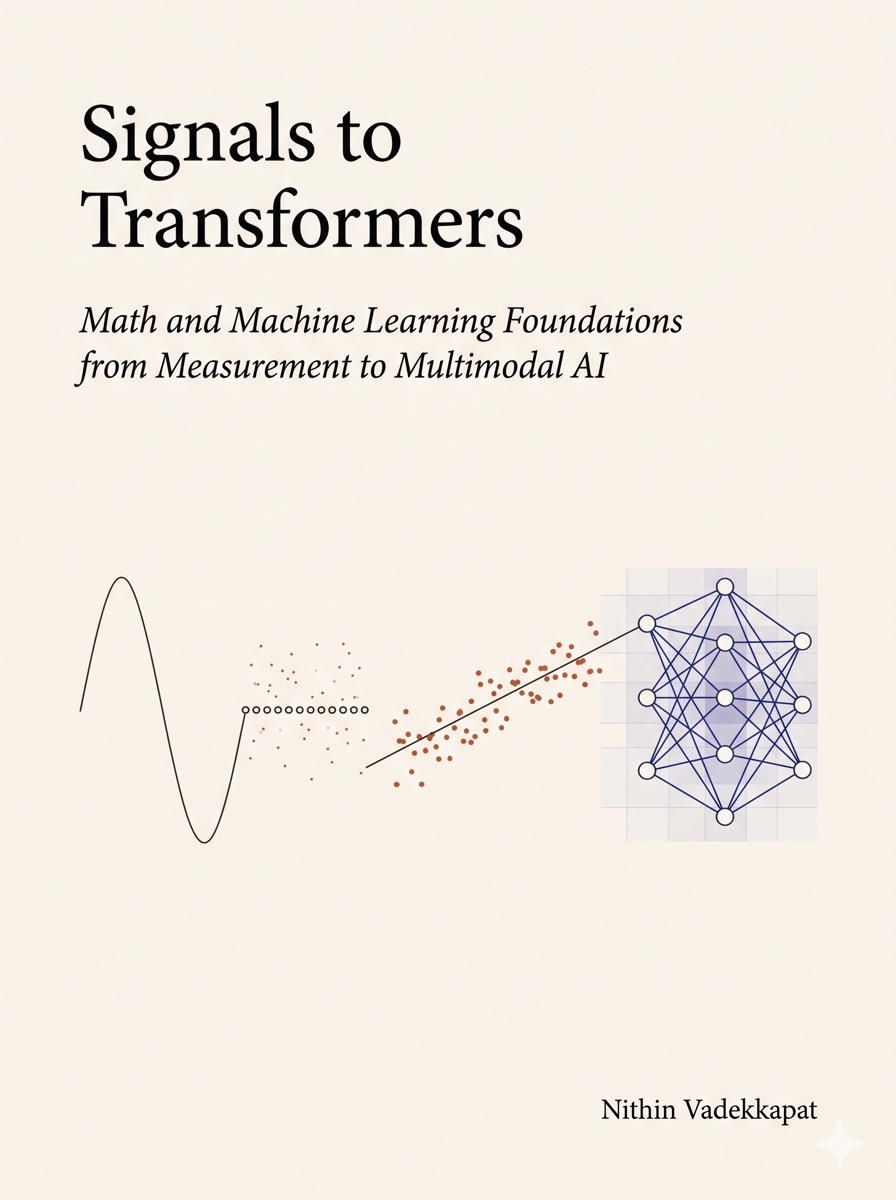
Math and Machine Learning Foundations from Measurement to Multimodal AI.
A single long-form book written for practitioners who want to understand modern AI from the ground up. The narrative runs from measurement physics and noise (what a sensor actually produces), through classical signal processing (how pixels and features work), into the mathematical foundations (probability, linear algebra, optimization), and up to modern deep learning (CNNs, attention, transformers, vision-language models, and multimodal AI).
The thread tying it all together is signals — physical, digital, and semantic. Pixels, tokens, audio frames, sensor streams: all signals. The book treats them that way from chapter 1.
Who it’s for
Computer vision engineers who want a firm grasp on the math and modern architectures.
ML engineers who want the physical / measurement grounding most ML textbooks skip.
Researchers and graduate students wanting one coherent narrative rather than stitching together a probability book, a DSP book, a deep learning book, and a transformers tutorial.
Structure
0.1Part I — Math Foundations
Probability, linear algebra, and optimization built from scratch, simulation-first: every concept is grounded in a Monte Carlo or vector-space experiment before the math appears. Each track ends with an applied capstone (sensor noise model; image patches as vectors). Start here if you need the math before the signal processing.
0.2Part II — Signals and Measurement
How a continuous scene becomes a digital array. Sampling, Nyquist, sensors, pixels, contrast, colour.
0.3Part III — Why Raw Signals Fail
What goes wrong when you try to do anything useful with raw pixels — motivates the entire rest of the book.
0.4Part IV — Learning from Signals
Convolutions, backprop, CNNs, training dynamics.
0.5Part V — Attention and Beyond
Self-attention, transformers, vision transformers, vision-language models, multimodal AI — where the field is going.
How this book is built
Each chapter is a paired .md (theory, math, pedagogy) + .py (runnable
simulation) file. The book renders via MyST Markdown; the scripts run as
standalone Python so readers can reproduce every figure on their own
machine.
0.6Why .md + .py instead of notebooks?
Publication-ready — MyST renders
.mdnatively. Cleaner than raw.ipynb.Reproducible —
.pyfiles run fresh every time; no stale cached outputs.Reviewable — git diffs read like prose. Notebook JSON diffs don’t.
Testable — standalone scripts drop straight into CI.
Iteration-heavy drafting happens in .ipynb elsewhere (e.g.
~/projects/nn-basics/fundamentals/). Stable material gets converted to
.md + .py and promoted here for publication.
Project layout
cv-ml/
├── README.md                              ← this file
├── myst.yml                               ← book config + TOC
├── pyproject.toml                         ← uv dependencies
├── math/
│   ├── probability/                       ← Part I — probability (complete)
│   ├── linear_algebra/                    ← Part I — linear algebra (complete)
│   ├── statistics/                        ← Part I — statistics (complete)
│   └── optimization/                      ← Part I — planned
└── book/
    ├── figures/                           ← all static figures
    ├── part2_signals_and_measurement/     ← Part II
    ├── part3_why_raw_signals_fail/        ← Part III
    ├── part5_learning_from_signals/       ← Part IV
    └── part6_attention_and_beyond/        ← Part V
Directory names retain their original
partN_*prefix to keep git history stable; the displayed part numbers in the rendered book follow the renumbered TOC (Part IV = Learning from Signals, Part V = Attention).
Running the code
cd ~/projects/cv-ml
uv venv
source .venv/bin/activate
uv pip install -e .

# run any part
python math/probability/part4_normal.py
python math/probability/part5_clt.py
Building the book
# install MyST CLI if you haven't
npm install -g mystmd

# from the project root
myst build --html
# open _build/html/index.htmlStatus
| Part | Status |
|---|---|
| Part I — Probability | ✅ complete (part0–part6 + exercises + applied capstone) |
| Part I — Linear Algebra | ✅ complete (part1–part4 + exercises + applied capstone) |
| Part I — Statistics | ✅ complete (ch01–ch14 + exercises) |
| Part I — Optimization | ⏳ planned |
| Part II — Signals and Measurement | 🟢 chapters drafted (ch01–ch05) |
| Part III — Why Raw Signals Fail | 🟢 ch06 drafted |
| Part IV — Learning from Signals | 🟡 chapter scaffolding (ch09–ch12) |
| Part V — Attention and Beyond | 🟡 chapter scaffolding (ch13–ch15) |
License
Code: MIT
Content (prose, figures, pedagogy): CC-BY-4.0